
I approached watching the Netflix documentary Tiger King with some trepidation. In general, I don’t enjoy documentaries that involve people exploiting animals. I don’t like watching animals forced into unnatural situations. I can’t even watch fictional movies where the dog dies. So, Tiger King, which highlights a uniquely American brand of colorful sociopaths, insanity and nonsense, all set in the world of wild animal breeders, trainers and roadside zoos, is custom made to hit all my triggers.
I also have personal reasons that caused me to both dread the idea of watching Tiger King and also compel me to watch it. For several years, starting in the late 70s, my Dad raised tigers. I spent my formative years helping to raise tiger cubs, and helping to care for our grown, adult tiger who lived in our backyard.
Given this background, I found I had extremely strong opinions about the people featured in Tiger King, opinions that don’t mesh with the memes and hero worship of Joe Exotic that have exploded since the entertainment documentary began to air. But I’ve also found myself stymied to figure out how to express these opinions. Based on my first hand experience, I can tell you all these people are terrible. But then, why do I have first hand experience? That’s a nugget you can’t really share without providing some kind of explanation.
Since watching Tiger King, my brother and I have discussed it several times, trying to mesh our understanding of this chapter in our family’s life. There’s a lot of it that neither of us know, exactly. Our memories are filtered through the lens of childhood and are now, at least for me, addled by age. As children, we both found the experience amazing and magical, but as we’ve aged, we’ve struggled to find context for it. We believed what we were doing was noble, furthering the cause of saving endangered animals. But this is a child’s understanding, through a lens of a shared hero worship of our father. As adults, the entire episode has taken on a giant question mark in our lives. What the hell was that?

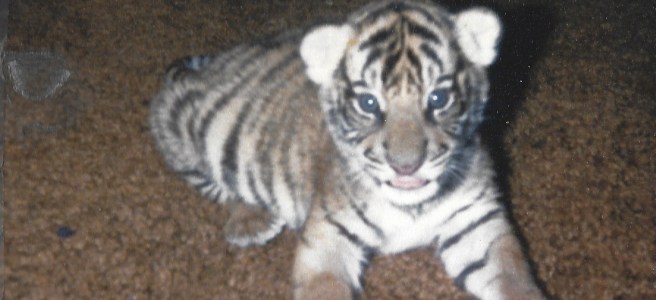
My brother David with tiger cub in the early 1980s
In the mid 70s my Dad was a young research scientist working in North Carolina’s Research Triangle Park. Through the grapevine he heard about the work of a geneticist from the University of North Carolina named Mike who specialized in the genetics of apex predators. Mike had a jaguar that had died mysteriously, and was concerned it might be from feline leukemia. Feline leukemia, unlike the human varieties, is contagious, which would make a breakout in a big cat research population devastating. My Dad was an expert on diseases like leukemia and he reached out to Mike offering his help.
My Dad became enthusiastic about Mike’s work, and they became friends. Ideas of the best way to protect wild animals from extinction evolve over time. In the 70s people were frantic over how severe the threat of extinction was for so many animals. Populations in the wild were dwindling so dramatically there was a legitimate fear that we were losing or might have already lost genetically viable breeding populations of many species, particularly apex predators like tigers.
Mike worked with zoos to help promote genetic diversity and avoid inbreeding in zoological wild cat populations. Zoos often do breeding exchanges, mating animals from different zoos, in order to ensure healthy animals. Because wild cats are incredibly private, breeding cats in captivity is a tricky business. Mike helped develop methods for breeding wild cats in captivity and raising the litters that were extremely successful. With the eye of a geneticist, Mike kept track of health issues, animal traits and other genetically influenced characteristics of all the animals in his care.
Raising tiger litters is an emotional and labor intensive process. They require regular attention and feeding, and an eye on their health and any issues that might arise. I don’t know if this is still the case, but at the time it was common in captive animal breeding to raise the cubs by hand to ensure the cubs weren’t harmed by the mother or other tigers. It also helped the babies grow up feeling comfortable around humans. In order to make sure each cub got the attention and care it needed, Mike had a small group of friends, my father included, who would be given a cub to care for until it became old enough to eat exclusively solid food and hearty enough to be moved to one of Mike’s outside compounds, or sent to its new zoo home, usually about 8 weeks old. For many years our family had a revolving door of baby tiger and jaguar cubs, usually one at a time.
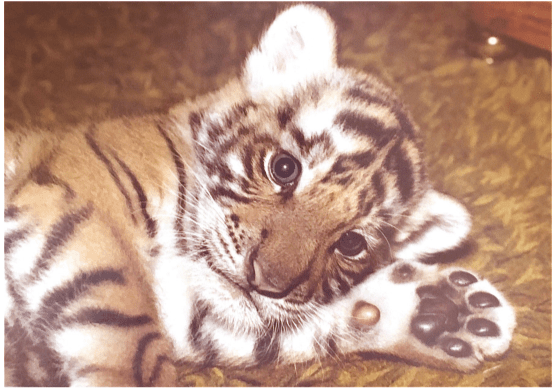
There’s pretty much only one reaction for a 10 year old whose Dad suddenly has a baby tiger, and that is to be completely over the moon. Baby tigers are the softest things you will ever hold. Baby tigers have a sweet musk that smells like Chanel #5. Baby tigers make the sweetest little squeaks, grunts and growls. Baby tigers like to suck on your finger, like a binky. Baby tigers drink milkshakes of raw chicken and baby formula from baby bottles, with milk dripping down their sweet little faces. Baby tigers are the bomb.
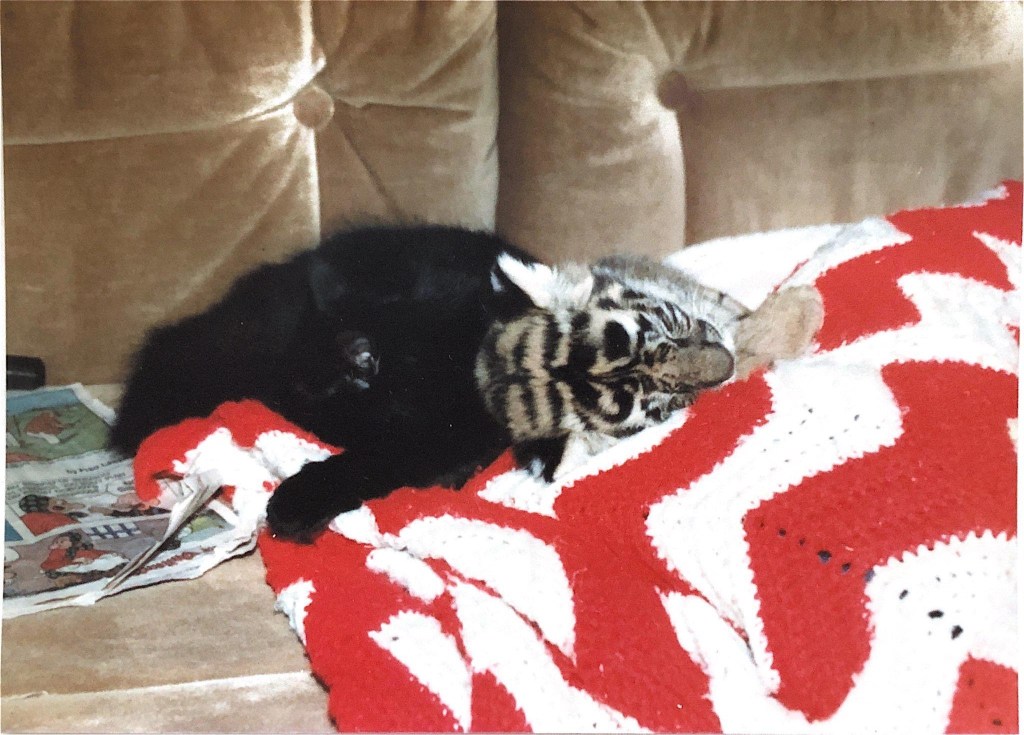
Baby tigers are also definitely not kittens. My father was always adamant that they were not pets. For one thing, they’re larger than kittens, and exponentially stronger. A scratch or nip can do real, permanent damage. House cats have been domesticated for thousands of years. They have an instinctive connection with humans, and have altered their behavior over thousands of years to better coexist with us. Baby tigers, or any baby wild cat, are trainee apex predators. As children we were not allowed unfettered access to the babies in our care, and were generally not allowed to be alone with one.
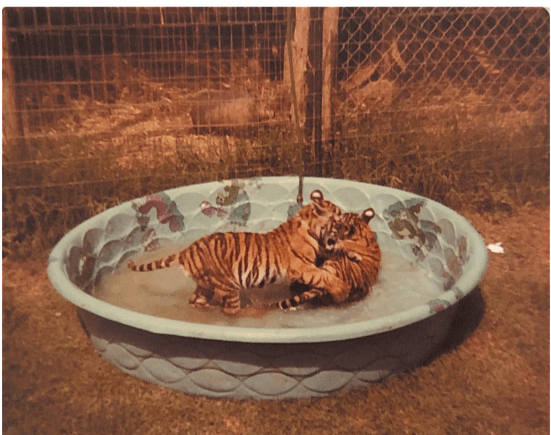
People who attempt to keep big cats as pets usually discover their mistake the hard way. Adorable behavior in a three pound cub quickly becomes dangerous and destructive. Wild cats instinctively mark their territory, which means pee all over your house. Not just any pee. Giant assed wild animal pee. A normal daily claw sharpening session and there goes your sofa, or a wall, or a door that is supposed to be keeping them inside. Add all this to the fact that cats are perfectly designed killing machines, and you have a recipe for disaster for humans and animals alike.
After many years of fostering babies for Mike, my Dad and stepmom bought a large piece of property in rural North Carolina. Mike offered my Dad the opportunity to raise and keep a tiger into adulthood. My father built a large tiger-proof compound – essentially two 20 by 20 foot cubes of chain link fortified with concrete, including a “roof” so there would be no way to climb out. The cubes were attached by a chain link corridor, or “air lock”, so that an adventuring animal would need to pass through multiple doors to get out of the pen. The compound included a wooden hut for a den, some tree stumps and other enrichment toys.
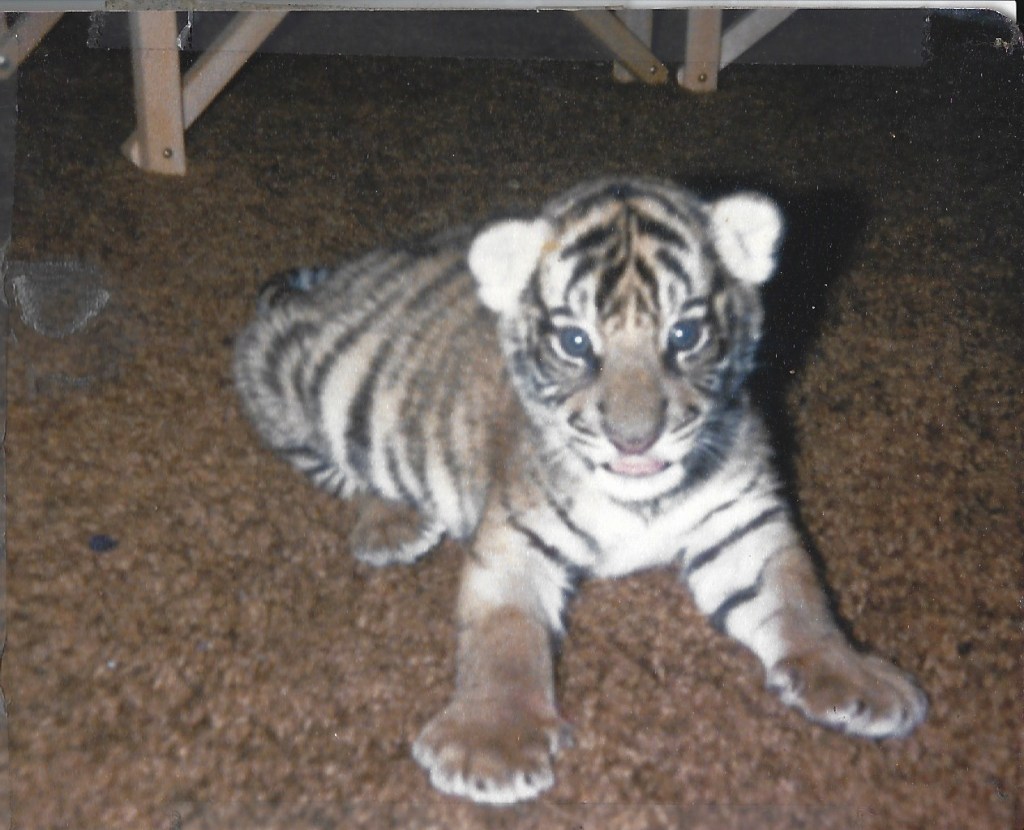
When we were ready, Mike delivered us a Sumatran tiger cub. We named her Kogo after the unusual stripe pattern on her forehead that looked like the Japanese kanji character for empress. She grew up and moved out to the compound, and became part of our daily lives. It was cool, but also just normal. We fed her chicken or rabbit. As a teenager, feeding Kogo became part of my daily chores. I delivered her meals through a hatch designed for safely delivering food, and then went to feed the dogs. It was cool and also A Drag, like all chores. Once a month Dad would go get a crate of raw chickens from the local butcher, and it was my job to pull out the gizzards and divide the chickens into plastic bags which were stored in the freezer. Sorting chickens was freezing and gross in the winter, and disgusting and foul in the summer. I still have issues with raw chicken, especially the smell. My brother has similar memories about gutting rabbits which I have either repressed or was not party to.
I loved Kogo although maybe not as much as I loved my dogs. I respected that she was not a pet, but more like a revered guest. Still, she was a good listener, and I would often go out and pour my teenage pains and traumas out to her while scratching her head and ears through the cage. I learned to chuffle (the low, snuffing sound that large cats make to indicate contentment) and often received chuffles in return.
It’s a strange thing to have an exceptional experience, like raising tigers, become a mundane fact of your life. I mention it sometimes, but then find myself stuck trying to explain. I’ve even been asked to write about it but haven’t known how. It was wonderful, and odd. It was inexplicable and profound. It was an event without an arc, like all good stories need. For a while, we had tigers, and then we no longer did, for no more dramatic reason than we moved. Kogo went back to Mike, and we moved to a different state.
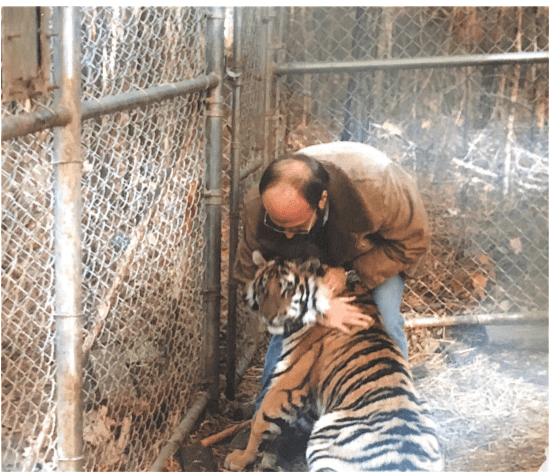
Mike passed away a few years later, and his organization began to shift focus away from breeding. Now they focus exclusively on rescue and sanctuary, taking in tigers and ocelots which have been rescued by animal control or abandoned by the person who realizes they’ve made a poor life choice by inviting a tiger into their apartment. Or, animals that have been purposefully bred for businesses like those of Joe Exotic and Doc Antle and then abandoned when they have no more use.
Based on what I know, I can tell you that almost everyone in Tiger King is awful. Awful, terrible people. All of them are guilty in some way of using tigers for their own personal aggrandizement. As a piece of car crash entertainment, Tiger King is certainly riveting. But, if you’re looking for real insight into the plight of the tiger and other captive bred endangered species, Tiger King is a failure.
As the story unfolds, the documentary works hard to create a narrative that all of these wacky, colorful characters are somehow equally guilty of using animals for their own ends. This serves the narrative which, I think, is “animal people are cray-cray”. The problem with reality entertainment is that it often attempts to cram real life events into the rigid frame of story, creating heroes and villains, and implying clear motivations and intentions. Actual life rarely fits comfortably into this structure, and reality is often much more muddy. When the filming of Tiger King began, it was, perhaps, a look at the wacky world of wild animal people, but by the end of it, the titular hero had killed some of his tigers because they were too expensive to feed, starved and underfed others, burned down his alligators for the insurance, stolen all his parent’s money and taken a hit out on someone.
Instead of going back to adjust the narrative, the film maker tries to roll with these things, like they’re a coda. This means sticking with his created narrative that all of these people are equally guilty, but especially Carole Baskin, who is extra equally guilty. However, if you actually care about the welfare of these animals, there is no comparison of what Carole is doing versus what Joe and Doc are doing. I don’t defend who Carol is as a person, but she is one of a small group of people and organizations in this country that are trying to provide an ethical solution to the problems caused by people like Joe Exotic and Doc Antle. That is why Joe, Doc and the rest of them hate her so much, and spend so much energy trying to destroy her. Given what else is revealed about Joe, Doc and the rest of them, do you actually believe they care if Carole killed her husband?
It matters that Joe and Doc continually breed their animals, forcing females to carry multiple litters a year to produce their bread and butter of tiger cubs. It matters that they take those cubs and force them to spend their days being passed from person to person to get their pictures taken. Baby tigers don’t emerge as sweet, docile kitties that enjoy being mauled by strangers. They’re drugged, declawed and even have their teeth filed or pulled to make them “safe”. Often they are purposefully underfed, because malnourished cubs stay smaller longer. When those cubs are no longer useful, no longer “money makers”, they are often euthanized or sold to some idiot who thinks having a tiger would be nifty.
For real insight to the true motivation of Joe’s crusade against Carole, you need look no further than the incident of the rabbits. Joe uses a photo of volunteers at Carole’s organization holding some freshly killed rabbits to gin up anger that Carole is an animal abuser. How can she claim to care about animals when she would viciously murder bunnies in cold blood?
Of course this argument is the height of hypocrisy. Spending time with carnivores means spending time with raw meat and carcasses. Carnivores need meat to survive and be healthy, and the closer to a whole, fresh carcass it is, the better it is. Freshly killed rabbit is a healthy, nutritious meal for a big cat. Joe feeds his animals a diet of expired meat from the local Walmart, which is questionable, especially if it’s been preserved and salted. He also clearly struggles to feed them enough. Carole is feeding her cats a healthy diet and Joe is perilously close to abuse with the diet he gives his cats. Joe knows all these things, but he chooses to weaponize Carole’s superior care of her animals against her.
For the purposes of the story that unfolds, the murder of Carole’s husband is a red herring that allows Joe, Doc and even the film maker to claim she’s “just as bad” or “worse” than the others. But if you are judging these people on how they care for the animals in their protection, there’s no contest. The greatest sin in America is to interfere with a man’s business, even if the business itself is sketchy or criminal. Carole isn’t perfect. There’s plenty to find fault there. But according to Tiger King her real crime was meddling in a man’s livelihood, which happened to be the exploitation, abuse and murder of animals.
I used to talk about our life with tigers more when I was younger. It was irresistibly tempting to drop it into conversations, because I wanted it to say something about me. I’m not just a regular person. I’m secretly The Mother of Tigers. As I got older, it became more difficult to talk about, because the reality is that confessing you once had a tiger is much more likely to evoke images of Tiger King-esque exploitation or mental illness than it is to suggest a contribution to science.
When I approached my Dad to talk to him about this, he was extremely reluctant to discuss it, and I understand why. He’s been on the same journey that my brother and I have. Forty years ago mankind was desperate to try and save these animals from extinction. Forty years later, the state of animals in the wild is more perilous than ever, while the methods developed for breeding cats in confinement have led to an explosion of captive animals, most of which are being exploited in some way. It’s heartbreaking, and profoundly uncomfortable, to acknowledge your noble intentions did not achieve what you’d hoped.
Many zoos in this country work exceptionally hard to provide humane, enriching experiences for the animals in their care, while educating the public on animals and how to protect them. But zoos straddle an uncomfortable line between education and entertainment, and too many of them, primarily private zoos like the ones belonging to Joe Exotic or Doc Antle are not interested in providing healthy, humane care for animals. They’re interested in making money.
My feeling about my own experience are so complex I still don’t know how to untie them. I have received so much from my experience with animals of all stripes, from the mundane to the extraordinary. Some of my most vivid memories are from zoos and from my own experience with tigers. I would not trade these experiences, but I live with the discomfort of never fully knowing the impact I’ve had, be it positive or negative.
Spending time with tigers taps into something deep and primal. I understand the ache, the yearning that spending time with wild animals can evoke. I understand the desire to connect, to know something that is unknowable, to be honored that a deadly beast might love you, might single you out as something remarkable. The animal that the stars of Tiger King are the most expert at exploiting are humans by fixing a ticket price to that yearning. When you spend time with creatures that are powerful, dangerous, noble and exotic, you can start to believe those same qualities apply to you. This feeling can be intoxicating and irresistible, but as Tiger King clearly shows, the results for the animals are often devastating.
***
Coda: The most extraordinary thing about Tiger King is how unextraordinary the mistreatment of exotic animals is, both in the US and around the world. There are things you can do to help, and also things you shouldn’t do, if you want to help end animal exploitation and abuse. Don’t support private “zoos” that promote cub holding, or hands on time with wild animals. Don’t support circuses that use trained wild animals in their acts. And, for god’s sake, don’t buy dangerous animals as pets. If you find a wild animal baby of any sort, contact animal control or a local wildlife rescue. For a more realistic look at the dark side of keeping exotic animals as pets, watch the documentary The Elephant in the Living Room.
Support organizations that focus on habitat preservation and restoration, and protecting wild animals in the wild. Support accredited zoos and animal refuges, but do your due diligence in researching them before you send money. Look for accredited non-profit organizations that are open about their finances. Do they have paid staff, especially licenced veterinarians or veterinary students or is it run by volunteers with limited experience? This speaks to the level of care the animals are receiving. If the parks are open to the public, what level of protection do they offer the animals, to prevent them from being stressed by over exposure to people? Contact your representatives and encourage them to pass legislation like HR 1380, the Big Cat Public Safety Act. which limits direct contact between the public and captive cats.
Resources:
Performing Animal Welfare Society http://www.pawsweb.org/index.html
Association of Zoos and Aquariums https://www.aza.org/conservation
World Wildlife Organization https://www.worldwildlife.org/
A Zoologists View of Tiger King https://www.theguardian.com/tv-and-radio/2020/mar/31/a-zoologists-view-of-tiger-king-a-crass-expose-that-could-do-some-good
What Tiger King Got Wrong https://www.insider.com/what-tiger-king-got-wrong-according-to-conservation-biologist-2020-4
Tiger King and America’s captive tiger problem https://theconversation.com/tiger-king-and-americas-captive-tiger-problem-135279

 Random Knowledge Syndrome
Thank you for sharing this. Knowing you as an adult, and how this experience has affected you (and David), that writing this wasn’t an easy task. I’m applauding you here for putting this out there, with tears in my eyes. Because I love you and animals. I don’t know who Joe Exotic, Carole or Doc are, because on some deep level I knew they were evil and there’s enough of that all ready. I chose not to watch. Yes……thank you. From my heart.
LikeLiked by 1 person